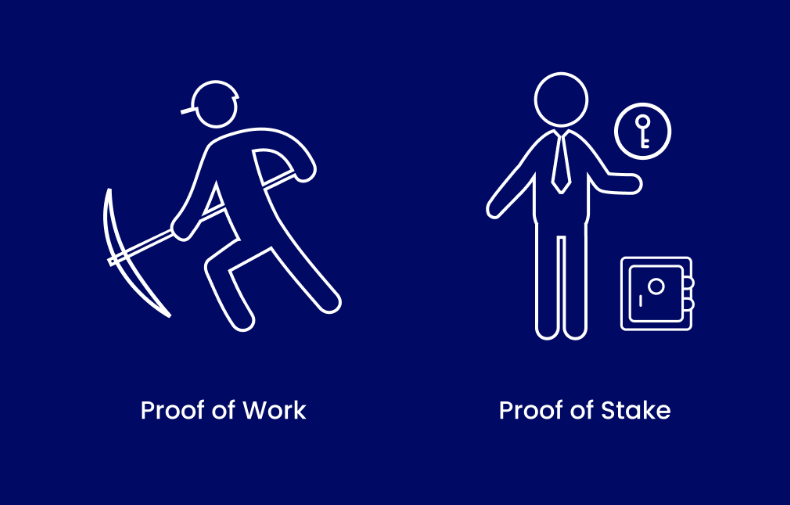
Cryptocurrencies rely on consensus mechanisms to maintain security, validate transactions, and prevent fraud. Two of the most popular mechanisms are Proof of Work (PoW) and Proof of Stake (PoS). Understanding their differences is key to understanding how blockchain networks operate and why they have different strengths and challenges.
What Is a Consensus Mechanism?
A consensus mechanism is a system used by blockchain networks to agree on which transactions are valid. It ensures that all participants share a consistent and tamper-proof record of the blockchain. Consensus mechanisms prevent double spending and maintain trust in decentralized networks.
Proof of Work (PoW) Overview
Proof of Work is the original consensus mechanism used by Bitcoin and many other cryptocurrencies. In PoW, miners compete to solve complex mathematical puzzles using computational power. The first miner to solve the puzzle gets the right to add a new block to the blockchain and receives a reward in cryptocurrency.
See also: Technology and Social Responsibility
How Proof of Work Works
- Transactions are grouped into a block.
- Miners use powerful computers to solve a cryptographic puzzle associated with the block.
- The first miner to find the correct solution broadcasts it to the network.
- Other miners verify the solution, and once confirmed, the block is added to the blockchain.
- The miner receives cryptocurrency rewards and transaction fees.
Advantages of Proof of Work
- Strong security due to the computational effort required to alter the blockchain.
- Battle-tested system with a long history of reliability, especially in Bitcoin.
- Decentralized and resistant to manipulation if the network has many participants.
Disadvantages of Proof of Work
- High energy consumption due to continuous computation.
- Requires specialized hardware, making mining less accessible for beginners.
- Slower transaction processing compared to some modern alternatives.
Proof of Stake (PoS) Overview
Proof of Stake is an alternative consensus mechanism designed to reduce energy consumption and improve efficiency. In PoS, validators are chosen to create new blocks based on the amount of cryptocurrency they hold and are willing to “stake” as collateral. The more coins staked, the higher the chance of being selected to validate a block.
How Proof of Stake Works
- Users lock up a certain amount of cryptocurrency as a stake.
- The network selects a validator based on stake size, randomization, and other factors.
- The validator verifies transactions and adds a new block to the blockchain.
- The validator receives rewards, often proportional to their stake.
- Misbehavior or dishonesty can result in loss of part or all of the staked coins.
Advantages of Proof of Stake
- Energy-efficient and environmentally friendly compared to PoW.
- Lower hardware requirements make it accessible to more participants.
- Faster transaction processing and higher scalability for many networks.
Disadvantages of Proof of Stake
- Wealth concentration risk, as users with more coins have more influence.
- Relatively new and less battle-tested than PoW in large-scale networks.
- Requires careful protocol design to prevent manipulation and maintain fairness.
Key Differences Between PoW and PoS
| Feature | Proof of Work | Proof of Stake |
|---|---|---|
| Validation Method | Mining using computational power | Staking coins to become a validator |
| Energy Consumption | High | Low |
| Hardware Requirement | Specialized mining rigs | Standard computers or wallets |
| Security | Very secure if network is large | Secure if staking is widely distributed |
| Speed and Scalability | Slower | Faster |
| Reward | Mining reward + fees | Staking reward |
Why Networks Choose PoS or PoW
PoW is preferred for networks prioritizing security and decentralization, like Bitcoin. PoS is preferred for networks seeking energy efficiency and faster transaction times, like Ethereum after its transition to PoS. Each mechanism has trade-offs, and the choice depends on the network’s goals and design priorities.
Conclusion
Proof of Work and Proof of Stake are both essential innovations in blockchain technology. PoW emphasizes security through computational effort, while PoS focuses on efficiency and accessibility through staking. Understanding these mechanisms helps users and investors grasp how different blockchain networks operate and why each has unique advantages and challenges.